Coming soon · In active development GNOME · “Nitida” Visual Layer · Fedora Atomic

CardinalOS — a desktop
built to respect your attention.

CodLab is designing CardinalOS, a European desktop operating system on a planned Fedora Atomic and GNOME foundation: with the in-development “Nitida” visual layer, ten planned applications in the Cardinal Family, and a design goal of zero mandatory cloud accounts or background telemetry.

Honest status (November 2026): CardinalOS is in development. No public release or downloadable ISO image exists yet. No release date or pricing has been set; the #notify channel on cardinalos.org sends a single availability notice.

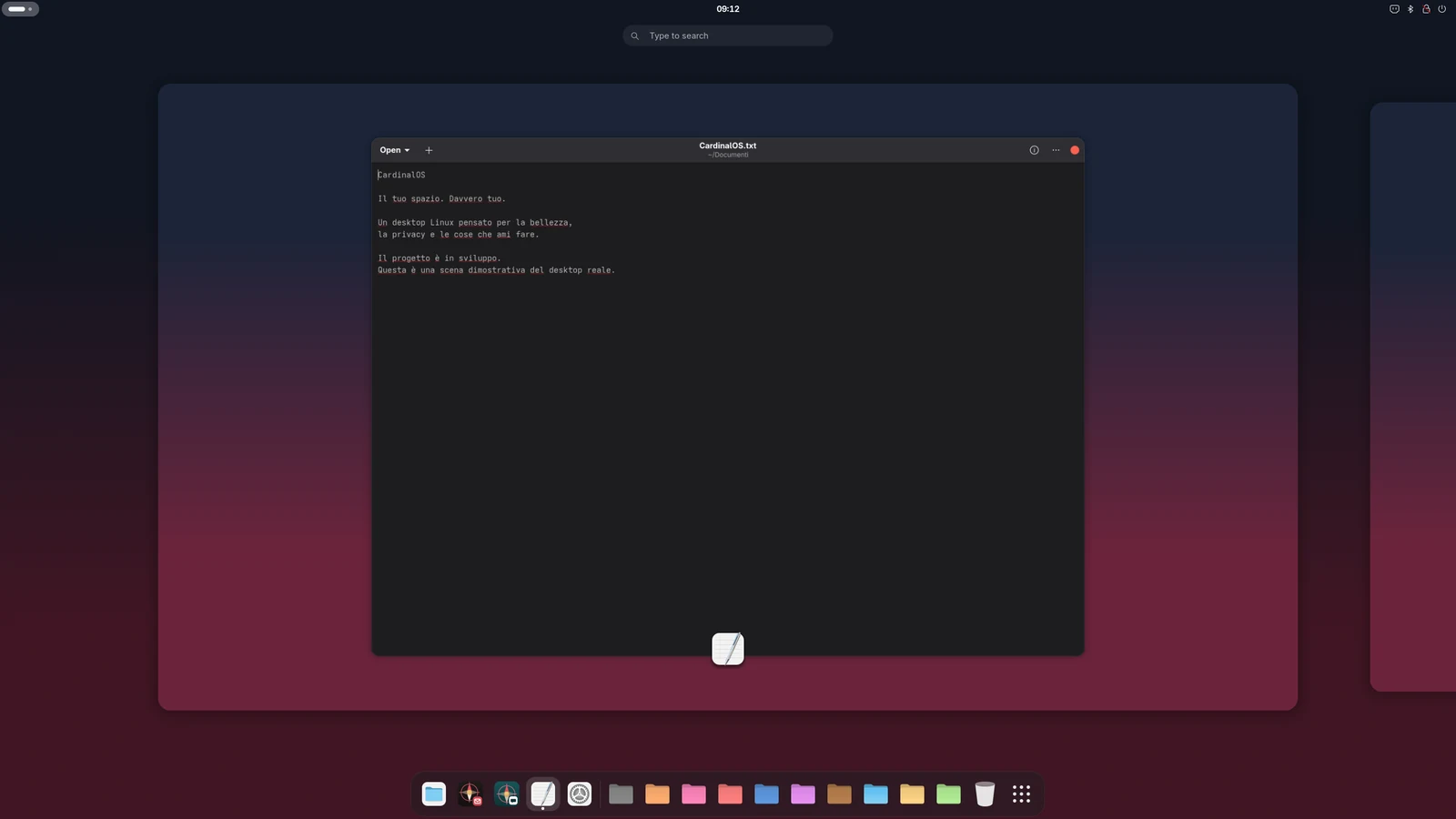
CardinalOS Isolated GNOME dev session
Real Shell overview capture from an isolated GNOME development session on November 11, 2026
Real development environment in an isolated GNOME session (November 11, 2026). CardinalOS is under construction — neither a released OS image nor proof of completed “Nitida” coverage.

What it is & who it is for

Intended for people moving from macOS or Windows — not terminal tinkerers.

Many people want a calm, dependable computer without ad tiles, forced cloud sign-ins, or uninvited AI pop-ups — without spending weekends editing configuration files. CardinalOS is being developed for daily work, study, creative projects, and gaming.

Everyday work & study (design goal)

Our goal is a consistent workspace after future installation: documents, spreadsheets, presentations, PDF tools, mail, and calendar sharing one calm interaction model.

Status: the planned Fedora Atomic base image (bootc) is not publicly delivered yet; no installable ISO is available today.
Creation & media (in integration)

Photo management, video editing, and audio/streaming tools belong to the ten planned Cardinal Family applications working locally on your files.

Status: individual candidates (such as Cardinal Photo) run on development machines while others undergo integration and license review.

Gaming & modern hardware (with clear limits)

Modern Linux graphics and audio stacks (Wayland, PipeWire, Mesa) are intended to run compatible game runtimes inside isolated Flatpaks or containers.

Boundary: compatibility, drivers, and anti-cheat must be verified title by title; kernel-level anti-cheat blocking Linux remains unsupported.

The “Nitida” design system (in development)

A single source of truth across top bar, windows, and dialogs.

Growing out of our «CodLab Thema» prototype study, “Nitida” maintains color, spacing, radius, and typography tokens in one JSON source compiled deterministically for GNOME Shell and GTK 4 / libadwaita.

Checked contrast & calm motion

In the design repository, automated gates validate light and dark token pairs against legibility thresholds; under prefers-reduced-motion, transition durations drop to zero.

Status: the generator and contrast judges run in the lab; live desktop integration is currently at unsigned partial preview stage, not yet covering dock, Overview, windows, or lock screen.

Honest boundary for third-party apps

The target is a unified look across system components and GTK 4 / libadwaita apps in the Cardinal Family as integration completes.

Boundary: third-party apps drawing custom toolkits (such as certain Electron or specialized tools) keep their native appearance without forced overrides.

The Cardinal Family

Ten planned applications standing on open shoulders.

Rather than reinventing proven engines from scratch, CardinalOS builds on respected open-source software with transparent upstream credits and licenses. Listing an app name here indicates a planned application in development, not a released package: six candidates are staged in development while packaging, signing, and license checks are completed prior to launch.

Cardinal Write

Write letters, reports, and structured documents with clean export — in development on proven open-source foundations.

Cardinal Sheets

Spreadsheets, calculations, and open document formats for office and study — in development.

Cardinal Slides

Calm, readable presentations aligned with the system typography — in development.

Cardinal PDF

Read, inspect, annotate, and merge PDF documents locally without cloud upload — in development.

Cardinal Mail

Mail, calendar, and contacts on the Thunderbird engine over open standards (IMAP, CalDAV, CardDAV) — in development, preview site live.

cardinalmail.org ↗

Cardinal Chat

Everyday and team messaging over open protocols without closed platform lock-in — in development.

Cardinal Photo

Browse and organize photos locally — staged on our development workstation, system integration in progress.

Cardinal Film

Video editing and media workflows for everyday creation on open foundations — in development.

Cardinal Studio

Recording, audio, and streaming tools on open foundations — planned, under license and integration review.

Cardinal Host

Remote support, file transfer, and remote terminal with command lock under construction — in development, preview site live.

cardinalhost.org ↗

Continuity, sovereignty & optional local AI

Open protocols instead of walled gardens.

Cross-device convenience and data sovereignty work together when built on open standards with clearly stated technical boundaries.

Continuity with Android & iPhone (lab stage)

Planned workflows pair Android over local Wi-Fi via KDE Connect / GSConnect and connect iPhones via standard Bluetooth SIG profiles (MAP, HFP), Apple’s BLE notification service (ANCS), and open CalDAV/CardDAV/IMAP accounts.

Status & boundary: verified against synthetic lab fixtures so far (physical phone radio and call-audio tests pending); AirDrop and iMessage remain closed by Apple.

Data sovereignty & backup design (target architecture)

Designed around no mandatory first-boot account and a zero-OS-telemetry goal. Sandboxed Flatpak apps without broader static overrides use XDG Desktop Portals; local Btrfs filesystem snapshots are designed to pair with client-side encrypted restic backups.

Boundary: OS image and network-filtering coverage remain in development; unisolated apps and user-configured external services follow their own policies.

Cardinal Intelligenza (opt-in & local)

We are designing «Cardinal Intelligenza» for verified local system Help: disabled by default (opt-in), returning extractive answers with SHA-256-checked citations to local Settings and Help texts. A separate local file index covers only filenames (and optional plain text) in explicitly chosen folders under single-use consent, never passing personal files to the language model.

Status: protocol candidate tested in the lab; GGUF model weights (llama.cpp) are not bundled and real CPU/GPU inference benchmarks remain pending.

Isolated development sessions

Captures from the development environment (November 11, 2026).

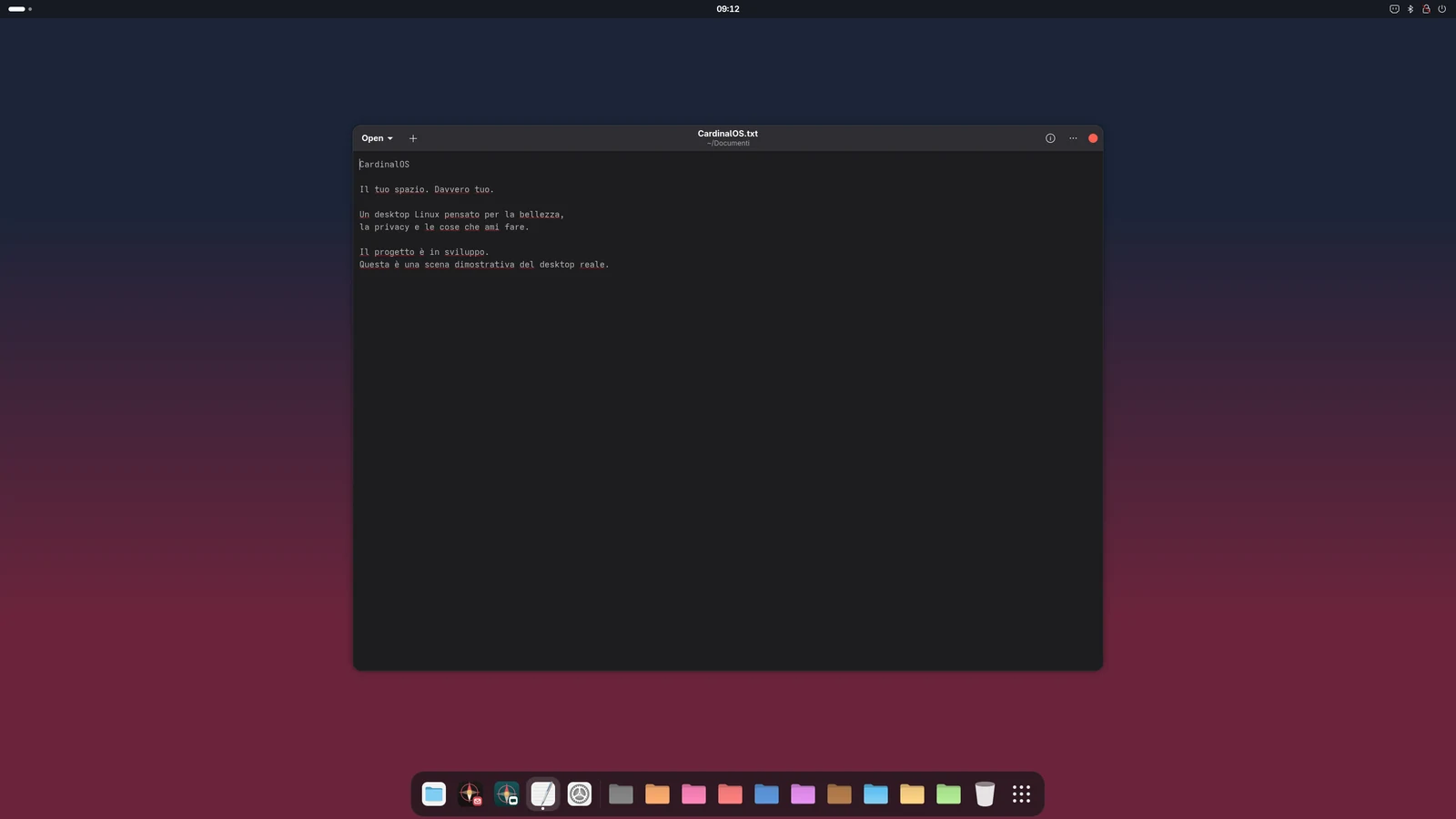
Both images come from an isolated headless GNOME 51 development session (2560 × 1440) showing a demo document and compositor gradient. They document a real development environment without attesting a bootable CardinalOS release or completed “Nitida” coverage.

Real Shell overview capture from an isolated GNOME development session on November 11, 2026
Real development environment (November 11, 2026): Activities Overview inside an isolated GNOME session — CardinalOS is under construction.
Isolated GNOME development workspace showing a demo document on November 11, 2026
Real development environment (November 11, 2026): workspace running a demo document in an open-source editor, not a released Cardinal app yet.

Engineering & research on the blog

Why and how we engineer CardinalOS.

Three articles by the CodLab editorial team examine single-source design tokens, open-protocol continuity, and desktop data sovereignty.

Follow the CardinalOS launch.

Explore the full product overview and sign up for the release notification directly on cardinalos.org.

Trademark notice: Fedora and Red Hat are trademarks of Red Hat, Inc. GNOME is a trademark of the GNOME Foundation. Linux is a registered trademark of Linus Torvalds. CardinalOS is an independent product by CodLab and is not affiliated with or endorsed by Red Hat or the Fedora Project.